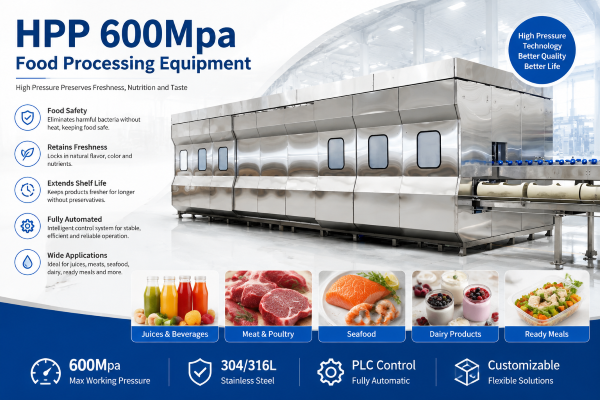
HPP sterilization equipment for cold sterilization of pre-prepared dishes
HPP (High Pressure Processing) sterilization equipment is a food processing system that utilizes physical cold sterilization technology. It applies extremely high hydrostatic pressure (typically 400–600 MPa) to sealed packaged food using water as the pressure transmission medium, thereby achieving sterilization. Because this technology requires no heating throughout the process, it is widely known in the industry as "cold sterilization" or "low-temperature sterilization."
Basic Principle: Packaged pre-prepared dishes or ready-to-eat foods are placed in a high-pressure container filled with water as the pressure transmission medium. A high-pressure pump system pressurizes the water to the target pressure (up to 600 MPa) and maintains it for a certain period. This pressure is uniformly and instantaneously transmitted to the interior of the food, causing microbial cell membranes to rupture, proteins to denature, and enzymes to inactivate, thus killing pathogenic and spoilage bacteria. Since pressure transmission is independent of product shape and size, uniform processing can be achieved regardless of the product's volume or shape.
Compared to traditional heat sterilization: Traditional heat sterilization (high-temperature cooking, pasteurization) relies on heat transfer, which easily leads to darkening of food color, softening of texture, deterioration of flavor, and loss of heat-sensitive nutrients (such as vitamins and anthocyanins). HPP technology completes sterilization at room temperature or low temperature (4℃~10℃), effectively preserving the original freshness, taste, color, and nutritional components of food.
II. Equipment Structure and Core Components
High-Pressure Vessel (Pressure Chamber): The most crucial component of the equipment, made of high-strength stainless steel (such as 316L or precipitation-hardening stainless steel) through integral forging or pre-stressed winding structure to withstand ultra-high internal pressure of 600 MPa and above. The vessel design must meet fatigue life requirements, typically capable of withstanding tens of thousands of pressurization cycles without failure. The inner diameter and length of the vessel determine the single-batch processing capacity.
Pressurization System: Composed of a high-pressure pump, a booster, and a pressure control system. The high-pressure pump boosts low-pressure water to an ultra-high-pressure level, and the booster further amplifies the pressure to the target pressure. The system must possess precise pressure control capabilities, typically within ±2%.
Temperature Control System: Although it's a cold sterilization process, the water medium and food will experience a temperature rise during pressurization (approximately 3°C per 100 MPa). The equipment is equipped with a heat exchanger and water circulation system to control the medium temperature within the set range, ensuring the processing temperature meets process requirements.
Material Loading and Unloading System: Used to load the products to be processed into the high-pressure container and remove them after processing. Large industrial equipment is typically equipped with automated loading baskets and conveyor systems to improve production efficiency.
Control System and Human-Machine Interface: Utilizes PLC (Programmable Logic Controller) control with a touchscreen interface. It can set and monitor key parameters such as pressure, holding time, and temperature, and record data for each batch, achieving full traceability.
III. Core Performance Parameters
Operating Pressure: The maximum operating pressure of standard industrial equipment is 600 MPa. Some models can be adjusted between 400 MPa and 600 MPa to meet the needs of different products and sterilization targets. For products where only extended shelf life is required, lower pressure can be used to reduce energy consumption.
Processing Capacity: Equipment capacity ranges from 2-10 liters for laboratory-scale, 35-100 liters for pilot-scale, and 150-525 liters for industrial-scale. Customizable capacity is a crucial factor in equipment selection, requiring consideration of production cycle time and investment scale.
Processing Time: The total cycle time for a single batch includes five stages: loading, pressurization, holding, depressurization, and unloading. Pressurizing to 600 MPa typically takes 2-5 minutes. Holding time is set according to the target microorganisms and product characteristics, usually 2-5 minutes. Depressurization is instantaneous. A complete cycle takes approximately 6-12 minutes. For example, a 300-liter container can process 5-8 batches per hour.
Operating Temperature: Conventional HPP processing is conducted within the range of 4℃-20℃, which is considered cold chain processing. Some special applications can be carried out below 80℃ to meet the specific process requirements of certain products.
Energy Consumption: Compared to heat sterilization, HPP technology significantly reduces energy consumption. Industrial data shows that the energy consumption per ton of product treated with HPP is approximately 30%–50% of that of heat sterilization.
IV. Application of Cold Sterilization in Pre-prepared Foods The pre-prepared food industry has developed rapidly in recent years, and the balance between product convenience and safety has become a focus of industry attention. While traditional heat sterilization can ensure safety, it often leads to flavor degradation and poor taste, failing to meet consumers' expectations for a "home-style" flavor.
Applicable Pre-prepared Food Categories: HPP cold sterilization is suitable for a variety of pre-prepared food products, including but not limited to: Chinese dishes (such as braised pork, Kung Pao chicken, and other reheated dishes), ready-to-eat salads, cold dishes, braised cooked foods, seasoned meat products, ready-to-eat soups, and seafood pre-prepared dishes. It is not suitable for products with low water activity (such as dehydrated vegetables and dried seasonings).
Quality Preservation Advantages: Pre-prepared foods treated with HPP retain significantly higher rates of color, texture, and flavor compounds than heat-sterilized products. The chlorophyll retention rate can reach over 90%, and the vitamin C retention rate exceeds 85%, while heat sterilization typically only retains 50%–60%. The product's taste is closer to that of freshly cooked food, and the quality degradation after reheating is significantly reduced.
Shelf life performance: Pre-prepared dishes treated with HPP can have their shelf life extended from 7–15 days for traditional products to 30–90 days under cold chain conditions of 0–4℃, depending on the product formula, initial bacterial load, and packaging barrier properties.
V. Ultra-high pressure processing of ready-to-eat foods Ready-to-eat foods have extremely high requirements for sensory quality; consumers expect products to be fresh when "opened and eaten." HPP technology has unique advantages in this field.
Ready-to-eat meat and poultry products: such as sliced ham, ready-to-eat chicken breast, braised beef, etc. HPP can effectively kill pathogenic bacteria such as Listeria, Salmonella, and Staphylococcus aureus, while not changing the tenderness and juiciness of the meat products. Studies show that treating ready-to-eat meat products at 600 MPa can extend their shelf life from 4 weeks to over 10 weeks.
Ready-to-eat seafood products: including ready-to-eat shrimp, crab sticks, smoked salmon, and ready-to-eat shellfish. HPP effectively kills marine pathogens such as Vibrio while maintaining the fresh, sweet flavor and elastic texture of seafood. For shellfish products, HPP can also achieve "cold shelling"—pressure automatically separates the shellfish meat from the shell, achieving 100% meat yield without manual shelling or cooking.
Ready-to-eat fruits, vegetables, and salads: HPP used in ready-to-eat fresh-cut fruits, vegetables, and salad products can kill surface pathogens and spoilage bacteria, extending shelf life to over 30 days while maintaining crispness and natural color.
Ready-to-eat sauces and condiments: such as ready-to-eat salsa, guacamole, and salad dressing. HPP prevents enzymatic browning, maintaining the product's bright green color without the need for chemical color-protecting agents such as sulfites.
