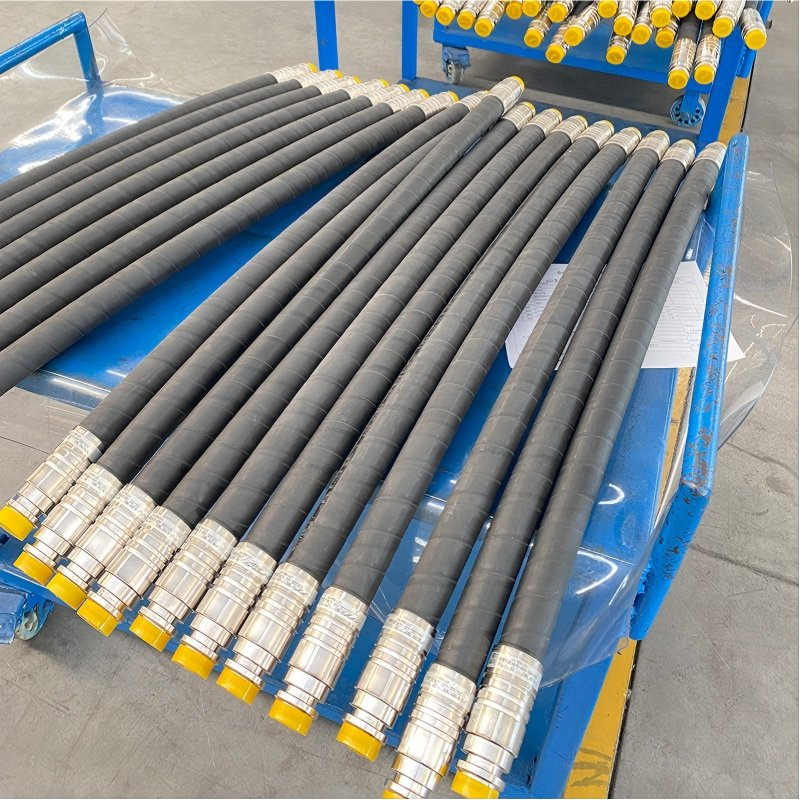
Energy storage battery pack water-cooled heat dissipation hoses
Customizable diameter fluid cooling hoses are a type of flexible piping product specifically designed for water-cooled heat dissipation systems in industrial equipment. They play a crucial role in transporting circulating coolant from the cooling source (chillers, heat exchangers, or cooling towers) to heat-generating equipment (welding power supplies, induction heating devices, lasers, injection molding machines, power electronic equipment, etc.). Their core value lies in providing a reliable coolant delivery channel while adapting to different flow rates and spatial layout requirements through customizable pipe diameters.
This product is widely used in the following scenarios: cooling circuits for medium- and high-frequency power supplies, induction heating equipment, and welding equipment; precision temperature-controlled water circuits in photovoltaic and semiconductor manufacturing equipment; cooling of optical components in laser cutting and welding systems; water circuit connections for mold temperature control units in injection molding equipment; and heat dissipation piping for power electronic equipment and variable frequency drives. Its core function is to safely and efficiently deliver the cooling medium to the heat source under specific pressure and remove heat from the equipment.
II. Structural Design and Material Composition Fluid cooling hoses typically employ a multi-layer composite structure, with each functional layer specifically designed according to the type of cooling medium and operating pressure.
Inner Layer (Inner Rubber Layer): In direct contact with the cooling medium, the material selection depends on the coolant type. For conventional cooling media such as water or water-glycol mixtures, EPDM (ethylene propylene diene monomer rubber) is typically used for the inner layer. It offers excellent heat aging resistance and hydrolysis resistance, and does not release metal ions into the coolant, preventing contamination of precision cooling circuits. For oily cooling media or applications requiring chemical corrosion resistance, NBR (nitrile butadiene rubber) or FKM (fluororubber) can be used.
Reinforcing Layer: Provides pressure-bearing structural strength, ensuring the hose maintains dimensional stability under system operating pressure. Reinforcement methods are divided into two categories based on pressure rating: fiber braided reinforcement is suitable for low-pressure cooling circuits (operating pressure 1.0–2.5 MPa), using high-strength polyester fiber braiding, balancing flexibility and pressure resistance; steel wire winding reinforcement is suitable for medium- and high-pressure cooling circuits (operating pressure up to 3.0–5.0 MPa and above), using single or multiple layers of high-strength steel wire spiral winding, providing a higher burst pressure margin.
Outer Layer (Outer Rubber Layer): Resistant to external environmental corrosion, typically made of weather-resistant synthetic rubber. CR (chloroprene rubber) or CSM (chlorosulfonated polyethylene) materials offer ozone, UV resistance, and oil resistance. In industrial environments with chemical splashes or oil contamination, the outer rubber layer must also possess good chemical resistance.
III. Customizable Pipe Diameters and Specifications
Pipe diameter customization is a core service capability of this product category. By flexibly adjusting the hose's inner diameter and wall thickness, it can match the flow requirements and installation space constraints of different cooling systems.
Inner Diameter Range: Standard product inner diameters typically range from 6mm to 100mm, with a wider customization range available. Small diameters (6–20mm) are suitable for localized cooling pipelines in precision equipment; medium diameters (25–50mm) are suitable for main cooling circuits in single-unit equipment; large diameters (50–100mm and above) are suitable for main pipelines in centralized cooling systems or high-flow equipment. Higher operating pressures or larger inner diameters result in more complex reinforcement layer structures and a larger bending radius.
Wall Thickness and Pressure Rating: Wall thickness is determined based on the working pressure. For the same inner diameter specification, different pressure rating options can be provided by adjusting the reinforcement layer structure and wall thickness. Multiple pressure rating versions are generally available for users to choose from based on their needs for the same inner diameter specification.
Custom Length: Hose lengths can be customized according to equipment layout and pipeline routing, reducing unnecessary joints and pipeline pressure drop, and improving system reliability. For long-distance transportation scenarios, some products support continuous seamless supply up to 20m.
IV. Performance Parameters
Temperature Range: The standard product's operating temperature range is -40℃ to +100℃, and some EPDM material products can be extended to +120℃. For high-temperature cooling applications (such as engine cooling water jackets, metallurgical equipment cooling), materials with higher temperature resistance ratings should be selected.
Pressure Rating: The working pressure of conventional industrial water cooling systems is generally between 0.3 and 0.8 MPa, and a few centralized cooling systems can reach 1.0 to 1.6 MPa. The hose's working pressure rating should be determined based on the system's working pressure; the burst pressure is typically 3 to 4 times the working pressure.
Cooling Media Compatibility: EPDM material exhibits good resistance to common cooling media such as water, water-ethylene glycol mixtures (1:1 volume ratio), and water-propylene glycol mixtures. For deionized water (pure water) cooling systems, a low-emission EPDM formulation should be selected to ensure that water purity is not reduced due to pipe material.
Bending Radius: Related to the hose's inner diameter and reinforcement structure, the bending radius of braided products is generally smaller than that of steel wire wound products of the same specifications, making them suitable for installation in compact spaces.
V. Selection and Usage Guidelines
When selecting custom-diameter fluid cooling hoses, it is recommended to focus on the following aspects:
Determine Inner Diameter and Flow Rate Matching: Select an appropriate inner diameter specification based on the system design flow rate and allowable pressure drop. An inner diameter that is too small will increase flow resistance and reduce cooling efficiency; an inner diameter that is too large will increase cost and installation space requirements. It is generally recommended to control the flow velocity within the pipe within the range of 1.5–3.0 m/s.
Confirm Media and Material Compatibility: Identify the type of cooling medium (tap water, deionized water, ethylene glycol aqueous solution, etc.) and confirm that the inner layer material is compatible with it. For cooling water containing chloride ions, the corrosion resistance of the materials must be evaluated.
Matching Working Pressure and Reinforcement Structure: Based on the system working pressure (including startup impact pressure), select a reinforcement structure with a sufficient pressure rating. A safety factor must be considered during selection; generally, the rated working pressure should not be less than 1.5 times the system working pressure.
Assessing Installation Space and Bending Requirements: Based on the internal space of the equipment and the piping routing, determine the required bending radius and select an appropriate reinforcement structure. An excessively small bending radius will shorten the hose's lifespan and increase flow resistance.
Consider Customization and Supply Capabilities: For non-standard diameters, special lengths, or specific color markings, confirm the supplier's customization capabilities and delivery time. Some manufacturers support value-added services such as printing on the pipe surface (e.g., cooling medium flow direction, pressure rating markings).
