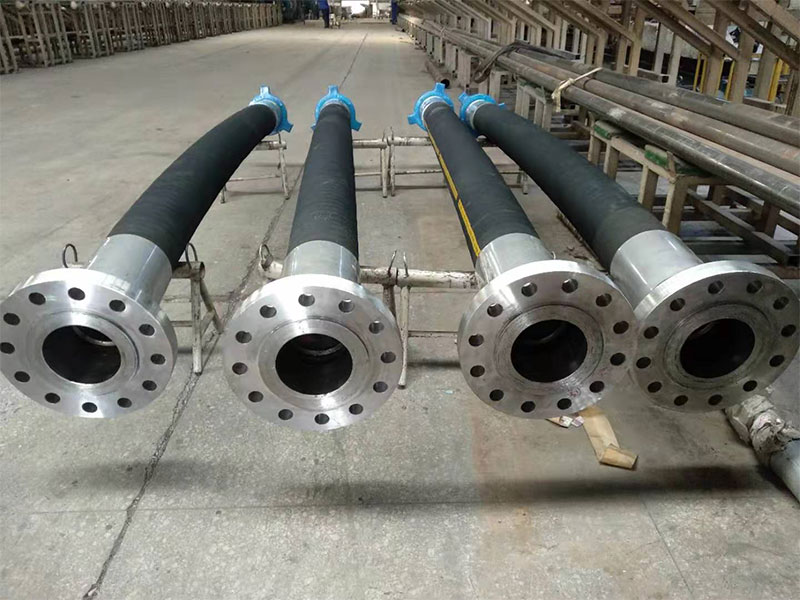
API Spec 16C Flexible Hose for Shale Oil & Gas Fracturing Operations
The 10000psi acid fracturing hose is a flexible piping product used in oil and gas field fracturing operations for high-pressure delivery of fracturing fluid. It is suitable for well completion and production enhancement operations such as acid fracturing, proppant fracturing, and hydraulic fracturing. This product serves as a flexible channel connecting the fracturing pump truck and the wellhead manifold, delivering acid, proppant-carrying fracturing fluid, and other completion fluids under high pressure conditions.
The 10000psi (approximately 69MPa) working pressure rating falls within the medium-high pressure range of fracturing hoses, suitable for medium-depth reservoirs and conventional fracturing operations. This rating balances pressure carrying capacity with hose flexibility and is used in production enhancement operations in shale oil and gas, tight sandstone, and carbonate reservoirs.
The core technical standard of the product is API Spec. 7K FSL0, and some products also meet API 16C requirements. For acidic operating environments containing hydrogen sulfide, the material must meet the NACE MR0175 sulfide stress corrosion resistance requirement.
II. Structural Design and Material Composition This product employs a multi-layered composite structure design, with each functional layer working together to meet the comprehensive requirements of high pressure load-bearing capacity, abrasion resistance, and chemical corrosion resistance.
Inner Layer: Ultra-high molecular weight polyethylene (UPE) is used as the inner lining material. UPE's abrasion resistance is significantly superior to ordinary rubber, effectively resisting the high-speed erosion and wear of the pipe wall by proppant (quartz sand, ceramsite, etc.) in fracturing fluid. This material also possesses good acid and alkali corrosion resistance, making it suitable for acid delivery in acid fracturing operations. Some products have a rubber protective layer behind the abrasion-resistant layer; when the abrasion-resistant layer is completely worn away, a warning-colored inner rubber layer is exposed, facilitating operator judgment on hose replacement timing.
Reinforcing Layer: Employs a multi-layered high-strength, ultra-flexible steel wire spiral winding structure, commonly 4 or 6 layers. The number of steel wire layers is determined by the pressure rating; 10,000 psi rating typically uses 4 or 6 layers of high-strength steel wire. The winding direction of adjacent steel wire layers alternates to balance the stress distribution of the pipe body in different stress directions. This structure exhibits outstanding high-pressure load-bearing capacity, with a burst pressure generally not less than 2.5 times the working pressure.
Outer Layer: Primarily constructed from wear-resistant and weather-resistant synthetic rubber. The outer rubber layer must withstand UV aging, ozone corrosion, and mechanical wear from contact with the ground or equipment during outdoor operations. Some products utilize a flame-retardant formula for the outer layer, enhancing safety during well site operations.
Temperature Range: Standard products cover an operating temperature range of -20℃ to +100℃, meeting the requirements of most fracturing operations.
III. Core Performance Parameters
Taking the 10000psi working pressure rating as an example, the main product parameters are as follows:
Working Pressure: 10000 psi (approximately 69 MPa), suitable for medium-depth reservoirs and conventional flow rate acid fracturing and proppant fracturing operations.
Test Pressure: 15000 psi, 1.5 times the working pressure, used for pressure verification before shipment.
Minimum burst pressure: Not less than 25,000 psi, 2.5 times the working pressure, providing ample safety margin.
Inner diameter specifications: Common specifications include 2 inches, 2-1/2 inches, 3 inches, 4 inches, etc., selectable according to operational displacement requirements.
Temperature range: -20℃ to +100℃.
Connection types: Optional hammer unions, API flanges, etc., adaptable to different wellhead manifold interfaces.
IV. Application Scenarios
Acidizing fracturing pipeline: In carbonate reservoir acidizing operations, acid is injected into the formation under high pressure to dissolve the rock and create flow channels. The acid resistance of the hose lining plays a crucial role in this scenario.
Propane-filled fracturing pipeline: In shale oil and gas and tight reservoir stimulation, fracturing fluid carrying proppant is pumped into the formation under high pressure to open fractures and improve oil and gas permeability. The erosion and abrasion of the pipe wall by sand-containing fluids is the main challenge under these conditions. The high abrasion resistance of the UPE liner effectively extends the service life of the hose.
Hydraulic fracturing pipeline: Used for conventional hydraulic fracturing operations, delivering water-based fracturing fluid to the wellhead.
Other high-pressure fluid delivery: Suitable for cement slurry delivery, high-pressure testing pipelines, and well kill pipelines in cementing operations.
V. Selection and Usage Considerations
When selecting a 10000psi acid fracturing hose, the following aspects are recommended:
Confirm pressure rating and operational compatibility: The 10000psi rating is suitable for medium-pressure fracturing operations. It is necessary to confirm that the actual maximum operational pressure does not exceed the hose's rated working pressure.
Assess fracturing fluid type and abrasion resistance requirements: For operations with high sand content and high sand particle hardness, the UPE liner should be prioritized; for acid delivery, the acid corrosion resistance of the inner layer material must be confirmed.
Confirm connection type: Select hammer unions or API flanges according to the wellhead manifold interface specifications to ensure a compatible connection.
Pay attention to suitability for acidic environments: If the fracturing fluid or formation fluid contains H₂S, confirm that the product materials meet the requirements for resistance to sulfide stress corrosion.
Check bending radius and installation space: Confirm the minimum bending radius based on the hose inner diameter specifications to ensure that the well site piping layout meets installation requirements.
Check certification documents: Confirm that the product has a type approval certificate and factory pressure test report according to API 7K or API 16C standards.
