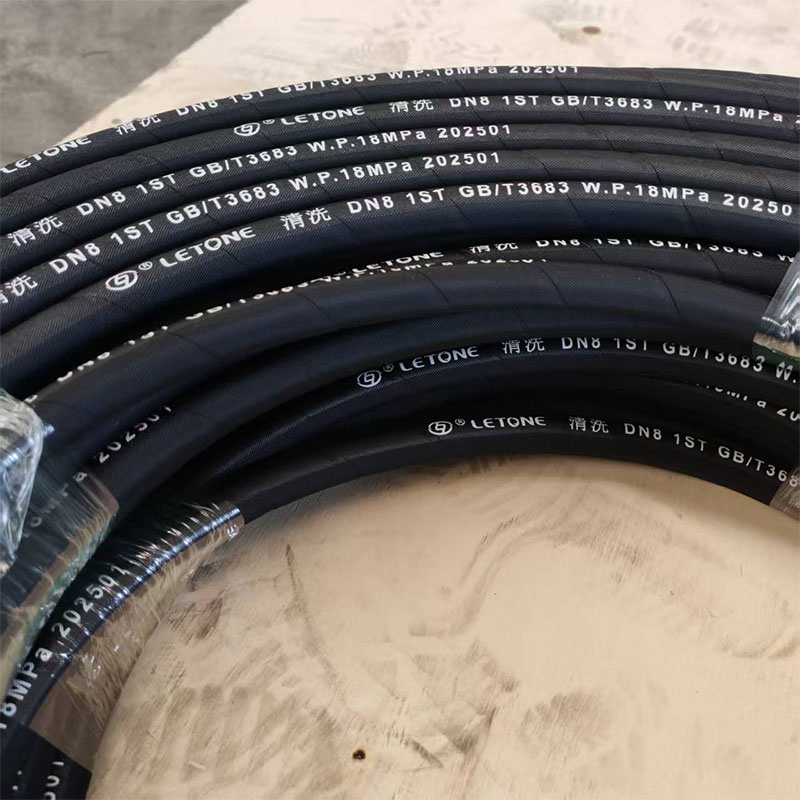
high-pressure PSI industrial oil hose
NBR/EPDM composite oil hoses are high-performance hydraulic piping products that combine the oil resistance of nitrile rubber (NBR) with the weather resistance of ethylene propylene diene monomer (EPDM). NBR exhibits excellent resistance to petroleum-based media such as gasoline and diesel, while EPDM provides the outer rubber layer with superior resistance to ozone, UV radiation, and weathering. Through a rational formulation design and blending process, the two rubber compounds achieve a synergistic effect—NBR acts as the dispersed phase in the outer rubber layer, providing oil resistance, while EPDM acts as the continuous phase, providing weather resistance, and chloroprene rubber (CR) acts as a compatibilizer between the two phases.
This product series covers a wide diameter range from DN10 to DN90, employs a steel wire winding reinforcement structure, and operates at pressures ranging from 2000-7000 PSI (approximately 14-48 MPa). Combined with the weather-resistant CR outer rubber, it is suitable for high-pressure oil transportation applications in oil extraction, construction machinery, and mining equipment.
II. Diameter Specifications and Pressure Ratings
DN10-DN90 full diameter range, covering various needs from precision control oil circuits to main oil circuits of large hydraulic systems. Larger diameter specifications (such as DN65, DN76, DN89 and above) are suitable for high-pressure, high-flow transportation scenarios such as oil drilling and production, mine hydraulic supports, and oilfield development.
Working pressure range: 2000-7000 PSI (approximately 14-48 MPa). Taking a four-layer wire winding structure as an example, the working pressure can reach 35-50 MPa (approximately 5000-7250 PSI), with a burst pressure four times the working pressure. Pressure ratings vary depending on the diameter; larger diameter products cover a pressure rating range of 10.3-34.5 MPa. Specific parameters are determined through negotiation between the supplier and the buyer.
Temperature adaptability range: Standard products operate from -40℃ to +121℃, capable of meeting the dual challenges of outdoor operations in extremely cold regions and high-temperature hydraulic systems.
III. Three-Layer Composite Structure Design
Inner Rubber Layer: Utilizing NBR as the main material, it exhibits excellent oil resistance and resistance to fuel swelling. For conveying petroleum products with high aromatic hydrocarbon content, a special formulation is required to ensure long-term durability. The inner rubber layer of large-diameter high-pressure hoses must also possess good resistance to water-based or oil-based hydraulic fluids.
Reinforcing Layer: Employing a multi-layer high-strength steel wire spiral structure, commonly four or six layers of copper-plated steel wire spirally wound. Adjacent layers are arranged in alternating winding directions to balance the stress distribution of the hose body in all directions. This structure significantly outperforms braided structures in terms of high-pressure load-bearing capacity; the burst pressure is generally not less than four times the working pressure.
Outer Rubber Layer: Utilizing an NBR/EPDM composite rubber compound combined with a CR (chloroprene rubber) weather-resistant outer rubber. EPDM provides the material with excellent resistance to ozone and UV aging, while CR further enhances its wear resistance, seawater resistance, and weather resistance. The phase structure design of the outer rubber layer is crucial—through a dynamic pre-curing process, oil-resistant NBR forms the dispersed phase, EPDM forms the continuous phase, and CR acts as a compatibilizer between the two phases.
IV. Material Selection Basis and Technical Points
**NBR/EPDM Blending Ratio:** In NBR/EPDM blends, the NBR content should ideally be controlled between 30-75% by mass. Too low an NBR proportion will reduce oil resistance, while too high a proportion will weaken the weather resistance advantage provided by EPDM. For the outer rubber layer, an NBR content of not less than 30% by mass ensures sufficient oil resistance, and an EPDM content of not less than 25% by mass ensures sufficient weather resistance.
**Synergistic Effect of CR Weather-Resistant Outer Rubber:** CR (chloroprene rubber) possesses excellent ozone, UV, and abrasion resistance properties, and is widely used in harsh environments such as marine oil hoses and offshore platforms. For diameters from DN10 to DN90, the weather aging resistance of the CR outer rubber can significantly extend the service life of the hose in outdoor or engine room environments.
Material application boundaries: NBR/EPDM composite rubber has good resistance to petroleum-based hydraulic oil and fuel, but for phosphate ester flame-retardant hydraulic oil, a special solution based on EPDM must be selected.