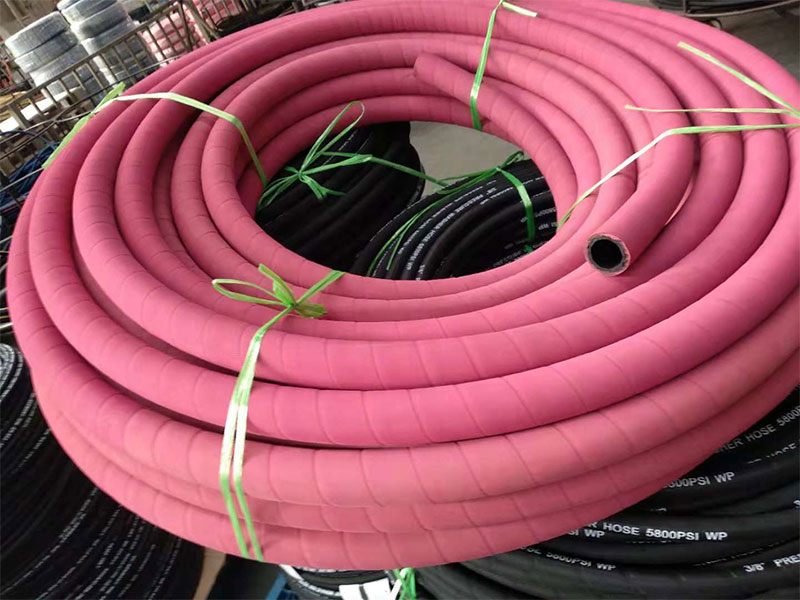
High temperature resistant steam hose for steam transportation at 180 ℃
High temperature steam hoses are a type of flexible piping product specifically designed for transporting saturated steam and high-temperature hot water. Their core application scenarios include industrial cleaning, equipment tracing, steam blowing, rubber vulcanization, food processing, and chemical production. The saturation pressure corresponding to 180 ℃ saturated steam is about 1.0MPa (about 10bar). This working condition puts forward clear requirements for the temperature resistance, pressure resistance and aging resistance of the hose.
The main technical standards for this type of product include GB/T 7548 "Steam Rubber Hoses and Hose Assemblies" and ISO 6134 "Specification for Rubber Hoses and Hose Assemblies for Steam Use". The above standards provide systematic regulations on the material properties, pressure ratings, testing methods, and labeling of steam hoses. Products are usually divided into multiple levels according to working pressure, and the 180 ℃ saturated steam condition generally corresponds to working pressure levels of 0.8MPa to 1.0MPa.
2、 Structural design and material composition
The high-temperature steam hose adopts a multi-layer composite structure, and each functional layer needs to maintain stable performance under the continuous action of high-temperature steam.
Inner layer (inner adhesive layer): It directly contacts high-temperature steam and is the key layer that determines the temperature resistance performance of the hose. The inner layer rubber is usually made of EPDM or a blend system of EPDM and butyl rubber. The saturated carbon chain of EPDM molecular structure endows it with excellent heat aging resistance and steam erosion resistance, and can maintain stable physical properties for a long time in a saturated steam environment at 180 ℃. An appropriate amount of antioxidants and anti-aging agents should be added to the inner layer rubber formula to delay oxidative degradation under high temperature conditions. The thickness of the inner layer is usually between 2.0mm and 4.0mm, depending on the inner diameter and pressure rating of the hose.
Enhancement layer: Adopting a steel wire weaving structure, commonly consisting of one or two layers of high-strength steel wire weaving. The weaving angle is controlled around 54 ° 44 'to balance radial compression capacity and axial flexibility. The steel wire material is usually copper plated high carbon steel wire, with a tensile strength of not less than 1800MPa, and the surface coating is used to enhance the bonding strength with rubber. The steel wire braided layer needs to withstand the internal steam pressure while also resisting the mechanical stress generated by the bending and movement of the hose.
Outer layer (outer rubber layer): The main material is heat-resistant and wear-resistant synthetic rubber, usually using chloroprene rubber (CR) or chlorosulfonated polyethylene (CSM). The outer rubber should have weather aging resistance, ozone resistance, and mechanical wear resistance, as well as certain flame retardant properties to meet the safety requirements of industrial sites. The outer surface is usually marked with identification bands along the length direction, indicating product specifications, pressure ratings, and temperature ranges.
End connectors: The joints of steam hoses usually adopt a buckle or detachable structure. The joint material should have high temperature resistance, commonly carbon steel or stainless steel. The connection strength between the joint and the pipe body must meet the requirement of no detachment or leakage under the design pressure.
3、 Core performance parameters
Working temperature: 180 ℃ is the typical delivery temperature for saturated steam. The hose must maintain its rated working pressure at this temperature without softening, expanding, or cracking of the inner layer rubber material. Some products can withstand higher temperatures for a short period of time, but the continuous operating temperature is still designed based on 180 ℃.
Working pressure: The saturation pressure corresponding to 180 ℃ saturated steam is about 1.0MPa. The rated working pressure of steam hoses is usually designed between 1.0MPa and 1.5MPa, with a burst pressure of 3 to 4 times the working pressure.
Inner diameter specifications: Common inner diameter specifications range from 13mm to 100mm, including 1/2 inch, 3/4 inch, 1 inch, 1-1/4 inch, 1-1/2 inch, 2 inch, 3 inch, etc. Small caliber is suitable for equipment heat tracing and steam blowing, while large caliber is suitable for steam cleaning and material conveying.
Minimum bending radius: Depending on the inner diameter and reinforcement layer structure, the minimum bending radius of steel wire braided reinforced steam hoses is usually between 5 and 8 times the diameter of the pipe.
Aging resistance: The combination of EPDM inner layer and CR outer layer endows the hose with aging resistance in high temperature and high humidity environments, delaying the performance degradation of the material under continuous steam action.
4、 Key points for steam working condition adaptation
Steam permeation and condensation: When steam flows in a hose, some of the heat is lost through the pipe wall, which may cause the steam to condense and form condensed water. The accumulation of condensed water at the low point of the hose may cause water hammer phenomenon, and pipeline layout and drainage measures should be considered when selecting.
Thermal expansion compensation: After the steam hose is filled with high-temperature steam, the length of the tube will change due to thermal expansion. When designing pipelines, thermal expansion allowance should be reserved to avoid excessive stretching or twisting of the pipeline due to restrictions.
Frequent alternation of hot and cold: Some operating conditions require steam hoses to be used frequently under alternating hot and cold conditions. Repeated thermal expansion and contraction can accelerate the aging of rubber materials and fatigue of the reinforcement layer. When selecting, attention should be paid to the thermal cycling performance indicators of the product.
Installation and support: Steam hoses should avoid excessive bending and twisting during installation, and the support spacing should be set reasonably according to the pipe diameter and medium temperature to prevent the pipe body from sagging or stress concentration due to self weight and thermal deformation.
5、 Application scenarios
Industrial cleaning: used for high-temperature steam transportation of equipment such as steam cleaning machines and steam generators, suitable for cleaning operations of food processing equipment, oil contaminated equipment, and industrial containers.
Equipment heat tracing: used to transport heat tracing steam to industrial equipment such as pipelines, valves, and instruments that require insulation, to prevent the medium from solidifying or increasing viscosity in low-temperature environments.
Steam blowing: Used for steam blowing operations in chemical plants, refineries, and power plants to remove residual materials from pipelines and equipment.
Rubber vulcanization: Used in the production process of rubber products to transport saturated steam required for vulcanization tanks.
Food processing: Used for steam transportation in food steaming, sterilization, and baking equipment, it is necessary to use adhesive formulas that meet the requirements for food contact.
Building maintenance: used for high-temperature steam transportation during the steam curing process of concrete.
