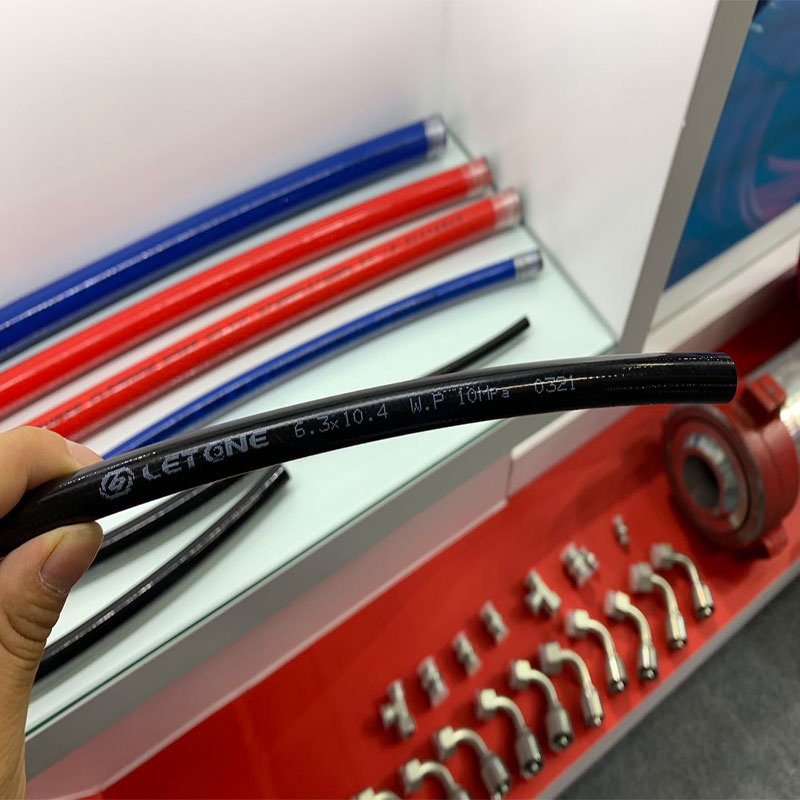
Cold plate and manifold connecting hose
Manifold jumper hoses are flexible piping components in data center cold-plate liquid cooling systems that connect the manifold and the server cold plates. Inside a liquid-cooled server rack, the manifold acts as a coolant distribution hub, distributing coolant from the cooling distribution unit to each server node. The cold plates directly contact the surfaces of high-heat-generating chips such as CPUs and GPUs to collect heat. The jumper hoses establish a flexible connection between these two components, handling the transport of coolant between the manifold and the cold plates.
This product is primarily used for liquid cooling of high-density computing equipment, including AI training servers, high-performance computing clusters, cloud computing data centers, and edge computing nodes. With the continuous increase in power density per rack, liquid cooling has become the mainstream thermal management solution for high-density data centers. As one of the most numerous and densely installed flexible connectors in the liquid cooling loop, the performance of the jumper hoses directly affects the system's heat dissipation efficiency and operational reliability.
II. Structural Design and Material Composition Jumper hoses typically employ a multi-layered composite structure, with each functional layer working together to meet comprehensive requirements for pressure resistance, temperature resistance, coolant corrosion resistance, and electrical insulation. Inner Layer (Inner Rubber Layer): Primarily made of peroxide-cured ethylene propylene diene monomer (EPDM). Compared to sulfur-cured systems, peroxide curing creates a more uniform cross-linked network and results in a lower extractable content, helping to maintain coolant cleanliness and electrical insulation properties. The inner layer must be compatible with the cooling medium, typically a water-glycol mixture or deionized water. The inner layer thickness is typically between 1.5 mm and 2.5 mm.
Reinforcing Layer: Woven with synthetic fibers or aramid yarns to provide pressure resistance. The weaving angle is controlled around 54°44' to balance pressure resistance and flexibility. For high-pressure liquid cooling systems, steel wire braiding reinforcement can be used.
Outer Layer (Outer Rubber Layer): Primarily made of weather-resistant or flame-retardant EPDM, with a thickness typically between 1.0 mm and 2.0 mm. The outer layer must possess abrasion resistance, ozone resistance, and flame retardancy. Data center equipment rooms have specific requirements for flame retardant performance; the outer layer of the adhesive typically needs to meet the UL94 V-0 rating.
End Connections: Jumper hoses are usually equipped with quick-connect or threaded connectors at both ends to adapt to manifold branch interfaces and cold plate inlets/outlets. Quick-connect connectors facilitate rapid insertion/removal and maintenance/replacement of server nodes. The connector material is typically stainless steel or brass, with passivated or nickel-plated surfaces to improve corrosion resistance.
III. Core Performance Parameters
Operating Pressure: The operating pressure of data center cold plate liquid cooling systems is typically between 0.1MPa and 0.3MPa, with some systems reaching 0.5MPa. The rated operating pressure of jumper hoses is generally designed to be 2 to 3 times the maximum operating pressure of the system, and the burst pressure is no less than 4 times the operating pressure.
Temperature Range: Standard products cover an operating temperature range of -40℃ to +100℃, with some products extendable to +120℃. This temperature range covers typical operating conditions for data center liquid cooling systems from cold start to full load operation.
Bending Radius: Connecting hoses need to be routed within the confined space of server racks, and the bending radius is typically 2 to 4 times the hose diameter. A smaller bending radius allows the hose to adapt to complex piping layouts within the rack.
Inner Diameter Specifications: Common inner diameters range from 6mm to 19mm, including 1/4 inch, 3/8 inch, 1/2 inch, 5/8 inch, and 3/4 inch sizes. Specific specifications are determined based on the cold plate flow requirements and the manifold branch interfaces.
Flame Retardant Rating: The outer layer must meet UL94 V-0 requirements to reduce the fire risk between data center equipment.
Electrical Insulation Performance: EPDM material has high volume resistivity, making it suitable for liquid cooling piping scenarios requiring electrical insulation. For high-voltage server systems, the hose's insulation performance helps maintain the system's insulation level.
Cleanliness: The zinc, aluminum, and halogen content of the inner layer must be controlled within limits to prevent precipitates from contaminating the coolant and clogging the cold plate microchannels.
IV. System Adaptation Key Points
Flow Rate Matching: The inner diameter of the jumper hose must match the flow rate requirements of the cold plate. An inner diameter that is too small will increase flow resistance and reduce cooling efficiency; an inner diameter that is too large will increase cost and installation space requirements. It is generally recommended that the flow velocity inside the hose be controlled within the range of 1.5 m/s to 3.0 m/s.
Quick-Connector Sealing Reliability: Maintenance and replacement of server nodes require frequent plugging and unplugging of quick-connect hoses. The sealing reliability and service life of the connectors are key performance indicators. The connectors must remain leak-free after multiple plugging and unplugging cycles.
Rigging: Rigging of the jumper hose within the cabinet should avoid sharp bends and excessive stretching. The bending radius must meet the minimum value specified by the product. Rigging supports and fixations should be properly installed to prevent displacement of the hose due to its own weight and vibration.
Coolant Compatibility: The inner layer of EPDM has good compatibility with water-glycol mixtures and deionized water. Note that EPDM is sensitive to oily antifreeze; when using coolants containing oily additives, their impact on the piping must be assessed.
