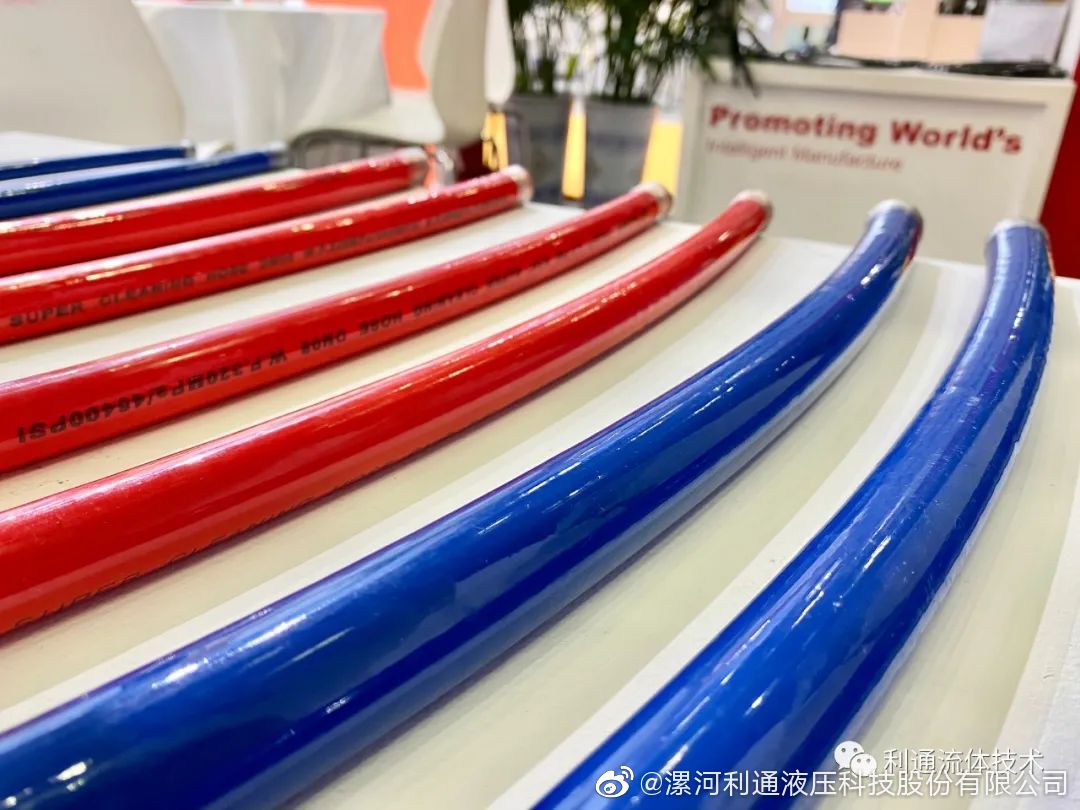
Nylon Resin Hose Flexible High Pressure Hydraulic Resin Hose
In the field of ultra-high pressure hydraulic transmission and fluid control, conventional rubber hoses exhibit a significant increase in volumetric expansion and a sharp rise in energy loss when operating pressures exceed 210 MPa, making them inadequate for precision control requirements. The multi-layer steel wire wound ultra-high pressure resin hose, featuring a thermoplastic nylon (PA12/PA11) inner liner, high-carbon steel wire as the reinforcement skeleton, and polyurethane as the outer protective layer, covers a working pressure range of 63 to 420 MPa and has become a widely adopted technical solution in the ultra-high pressure flexible piping domain.
I. Layered Structure and Material Selection
The hose body follows a typical three-layer composite structure, with each layer serving a distinct function.
The inner liner is made of PA12 or PA11, with a wall thickness typically ranging from 1.0 to 2.5 mm. It serves as the core component for sealing, pressure containment, and resistance to media corrosion. Compared to PA11, PA12 has a lower moisture absorption rate (approximately 1.5% versus 2.5%), offering superior dimensional stability after prolonged immersion, making it the preferred material for high-pressure measurement and long-cycle service scenarios.
The reinforcement layer uses high-carbon steel wire (grade SWRH72B), with individual wire diameters ranging from 0.3 to 1.2 mm and typically 4 to 6 winding layers. Its core function is to withstand hoop stress and restrict radial expansion. The wire tensile strength is no less than 1770 MPa, making it the decisive factor in the hose's pressure-bearing capacity.
The outer protective layer is made of polyurethane (TPU/CPU), with a wall thickness of 1.5 to 4.0 mm. It provides external protection against abrasion, UV radiation, and impact, while also imparting a degree of bending flexibility to the hose.
II. Wire Winding Angle and Mechanical Model
The core of multi-layer steel wire winding lies in the lay angle design. For single-layer wire winding, the angle between the wire and the hose axis is typically set at 52° to 55°, at which the wire primarily bears axial tensile load and hoop pressure-bearing efficiency is maximized. In multi-layer structures, adjacent layers are wound at alternating angles (e.g., +54°/−54°) in a cross-wound configuration, constraining the volumetric expansion rate under internal pressure to within 4% to 5%, compared to 10% to 15% for rubber hoses of equivalent specifications.
Based on thin-walled pressure vessel theory, the burst pressure of the hose body can be estimated as follows: burst pressure equals 2 times the wire tensile strength multiplied by the number of wire layers multiplied by the square of the sine of the winding angle, divided by the inner diameter. This relationship clearly indicates that increasing the number of wire layers and optimizing the winding angle are the two primary technical paths for elevating the pressure rating.
III. Key Performance Indicators
At the 63 MPa pressure rating, the burst pressure ratio is no less than 3:1, the volumetric expansion rate does not exceed 3%, the minimum bending radius is 5 times the outer diameter, and the operating temperature range spans from −40°C to +100°C.
At the 210 MPa pressure rating, the burst pressure ratio is no less than 2.5:1, the volumetric expansion rate is controlled within 4.5%, the minimum bending radius increases to 7 times the outer diameter, and the pulse life can reach over 10⁷ cycles.
At the 420 MPa ultra-high pressure rating, the burst pressure ratio remains no less than 2.5:1, and the volumetric expansion rate does not exceed 5%. However, the minimum bending radius further increases to 10 times the outer diameter, and the upper operating temperature limit narrows to +80°C, imposing stricter requirements on installation conditions.
IV. Engineering Applications and Selection Guidelines
In scenarios such as ultra-high pressure water jet cutting (350 to 420 MPa), hydraulic intensifier test benches, and deep-sea ROV hydraulic power units, multi-layer steel wire wound ultra-high pressure resin hoses have achieved flexible replacement of rigid metal pipes. Selection should focus on three key factors: the number of wire layers and winding angle precision, the media compatibility of the inner liner material, and compliance with SAE 100R7/R8 or ISO 14364 standards.
Conclusion
The multi-layer steel wire wound ultra-high pressure resin hose is fundamentally a precision mechanical system — material determines service life, structure determines pressure capacity, and process determines reliability. With ongoing advances in PA12 modification and steel wire pre-stressed winding technology, flexible piping solutions above 420 MPa are moving toward broader engineering adoption.
